What is the Family 35 Greek NT?
Most people know what the New Testament (NT) is, but few know the history of it. In a nutshell, the Family 35 Greek NT is the original New Testament that God inspired and preserved. Below is a summary of where and how it was transmitted and preserved, why it is so special, how it got its name, and how you can learn more.
The location of the original NT manuscripts
Because God loves us and wants two-way communication with us, He entrusted the task of recording His Word to around 40 of His loyal followers. The 66 books they wrote were immediately accepted as Scripture, or what we call the "Bible". The transmission process was supernatural. The Bible is divided into two parts. The first 39 books are called the Old Testament (OT), and they were mostly written in Hebrew, because the primary target audience at the time of writing was Hebrew-speaking people of the nation of Israel. The remaining 27 books are called the New Testament (NT), and they were mostly written in Greek, because the primary target audience at the time of writing was Greek-speaking people in the Roman Empire.
Of the 27 NT books, most were written to people living in Asia Minor (modern Turkey) and Greece. This area was the heartland of the early Church.
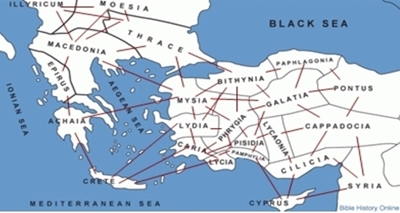
God arranged for these places to later become part of the Byzantine Empire, which retained the Greek language. Over the centuries, God ensured that holy men of God used the perfect copies to produce perfect or well-made copies, and these copies are spread all over Europe and the northern Mediterranean region.

The wonderful yet forgotten scribes
The primary agents God used were Greek-speaking scribes in the heartland of the early Church. Nowadays, few people appreciate the great importance of these scribes and their extreme detail orientation. Their great skill was actually something that was passed down from Jewish scribes, since all or most of the NT authors were Jews and all or most of the first Christian congregations were initially led by Jews. (See the Acts of the Apostles.) The God-given Jewish scribal instinct and heritage enabled Gentiles (non-Jews) to be grafted into the Kingdom of God. (See Romans 11:17-36.) The work of Christian scribes was so important that "scriptoriums" were built to give these scribes a good working environment. After the invention of the printing press, however, people gradually forgot the importance of scribal work. This may be one reason why most Bible scholars have embraced the false theory of Westcott and Hort that is now pervasive in most seminaries around the world.

Soon after each book was published, multiple perfect copies were made and distributed to churches in the heartland. Then, whenever one of the original manuscripts (aka autographs) or copies wore out, God made sure that perfect or well-made copies were carefully produced to replace them. Similar to blockchain technology, it was a distributed ledger in which integrity was assured by a common commitment to preservation among most congregations. It was a supernatural process.

Although not all copies were perfect, most were well made, and God ensured that some copies were indeed perfect. (See the Greek NT copyist care comparison chart below.) The validity of God's promises have depended upon this preservation process, so it has been a supernatural process - similar to the way that God preserved Noah and his family through the global flood (Genesis 6:1-9:19).
Greek NT copyist care comparison
| Manuscript | Copyists | Variants | Attitude of the copyists |
| Perfect Family 35 Byzantine (Majority) Text | Selected, humble and extremely detail-oriented slaves | None | Handling the inspired Word of God, desiring the work to be pleasing to God, fearful of making any mistakes, and supernaturally anointed by God (Isaiah 66:2; Matthew 5:17,18, Revelation 22:18,19) |
| Typical Family 35 Byzantine (Majority) Text | Humble and extremely detail-oriented slaves | 1 per several pages on average | Handling the inspired Word of God, desiring the work to be pleasing to God, and fearful of making any mistakes (Isaiah 66:2; Revelation 22:18,19) |
| Worst Family 35 Byzantine (Majority) Text | Serious detail-oriented believers | 1 per page on average | Handling the inspired Word of God and desiring to be faithful (2 Timothy 2:15) |
| Typical Byzantine (Majority) Text | Detail-oriented lukewarm Christians | 3-5 per page on average | Sufficiently careful, but merely doing their religious duty without strong personal committment to the Text (Revelation 3:15-18) |
| Best Alexandrian (Egyptian) Text | Non-believers | Over 12 per page on average | Just handling uninspired religious text, so the text can use some revision (inspired by Satanic or demonic influences; tares – Matthew 13:24-30) |
The spread of the Byzantine Text
For centuries, travel was slow, so the heartland of the Church was the primary area to find perfect copies of the original manuscripts. However, faithful servants of the Lord Jesus eventually hand carried copies to other places in Europe and the Mediterranean region. Before the internet, people who were serious about the Greek NT had to rely mostly on manuscripts available locally. But after the Internet was developed, hundreds of scans of Greek NT manuscripts have been posted online. Today, there are known to be around 3000 continuous-text manuscripts of varying quality. However, among the 3000 known continuous-text manuscripts of the Greek NT, around 95% are classified as the "Majority Text" or "Byzantine Text". They were preserved by Greek-speaking scribes of the Byzantine Empire until the printing press replaced their work. The 1848 Encyclical of the Eastern Patriarchs affirms this. If you are interested in seeing actual Greek NT manuscripts, you can visit The Center for the Study of New Testament Manuscripts (CSNTM), which provides over 2000 Greek manuscripts.
Why is the original Greek NT called "Family 35"?
Among all the Majority Text manuscripts, there are several "families". The largest family of independently transmitted manuscripts includes hundreds of well-made copies of the original autographs. Some are also perfect. It used to be called the Kr Family, but in recent years it was renamed "Family 35" or simply "F35". Family 35 is the only line of transmission within known NT Greek manuscripts that is consistent in its archetypical form in all 27 books.
The scribes who produced the core manuscripts that represent F35 clearly believed that they were copying Scripture. This can be seen from the extreme care that characterizes their work. No other line of transmission comes close to the level of internal coherence exhibited by F35. Furthermore, Dr. Wilbur N. Pickering has personally visited monestaries in Europe and the Mediterranean region to obtain his own copies. For decades, he has carefully compared manuscripts from all 27 NT books. God has used him to discover and explain that the Family 35 Greek NT text is so far superior to all other comparative text that some particular manuscripts are perfect copies of the autographs. This proves that God is indeed big enough to preserve all the original text of the Bible!
Family 35 got its name from the manuscript called "Cursive 35", which is the complete NT faithful to the family archetype, with the smallest manuscript number. (Cursive 18, also a complete NT, defects from the family in Revelation.)
Dr. Wilbur N. Pickering has shown that God has perserved the pricise original wording of the NT, just as He promised (Matthew 5:18). We can and do know what it is based on an empirical procedure. This procedure includes careful analysis of size, independence, age, geographical distribution, profile, care and range. Few Greek NT scholars have gone to the trouble to do this. Most simply look at age, which is really poor scholarship. They naively believe that older manuscripts are usually better, but this is not so, because the best old manuscripts easily wore out and had to be replaced. The manuscripts that did not wear out were usually poor ones that few people wanted to use!
Information to gain a deeper understanding of Family 35
God Has Preserved His Text!: The Divine Preservation of the New Testament, Fifth Edition, 2023
Family 35 Greek NT (The original inspired text given by God!)
The Sovereign Creator Has Spoken, Objective Authority for Living New Testament with Commentary, Fourth Edition, 2023
PRUNCH - Project Underground Church, Dr. Pickering's website
Defense of Family 35, Video series by Dr. Wilbur N. Pickering
Episode 00 - Introduction
Episode 01 - NT textual criticism and the spiritual factor
Episode 02 - The liturgical system
Episode 03 - Who was best qualified?
Episode 04 - What is a controlled text?
Episode 05 - Why there are no early Byzantine manuscripts?
Episode 06 - The oldest manuscripts are not the best
Episode 07 - Contemporary issues